
Heat protection gloves
Briefly gripping a hot workpiece and standing in radiant heat are two different loads. EN 407 tests them separately.
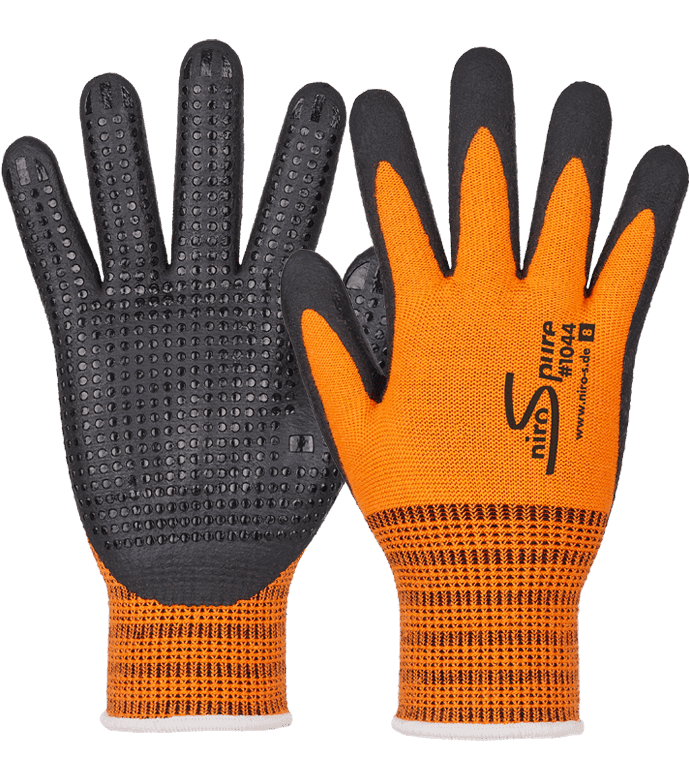
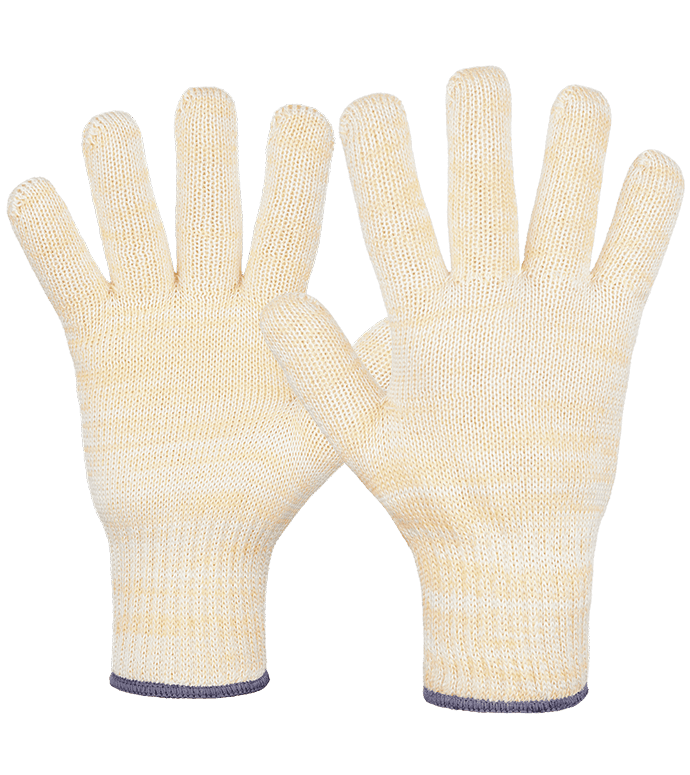
What matters here
EN 388 says nothing about heat resistance. Thermal risks are covered by EN 407 with a marking of its own, six digits: burning behaviour, contact heat, convective heat, radiant heat, small splashes of molten metal and larger quantities of molten metal. Each position is a separate test.
Contact heat and radiant heat are not the same thing. The contact heat test measures how long the glove holds off a given temperature before the inside warms by 10 kelvin. Anyone moving hot parts briefly needs a good value there; anyone standing beside a furnace looks at radiant heat.
A high value in one position means nothing for the others. A glove can hold off contact heat well and still be unsuitable for welding because it was never tested against metal splashes. Here too an X means not tested, not failed.
Heat protection costs dexterity, because it works through material thickness and insulation. For work where something hot is only occasionally handled, a model with limited contact heat resistance is often the more practical choice than a thick oven glove.
More on this: what the EN 388 digits mean and which glove suits which job.
Frequently asked
Are heat protection gloves suitable for welding?
Only if they are explicitly tested for it. Welding gloves are covered by EN 12477, which additionally accounts for metal splashes and working with the arc. EN 407 alone is not enough.
What does contact heat resistance up to 100 degrees mean?
That in the test the glove withstood that contact temperature for a defined time before the inside warmed noticeably. It is not a promise that a part at 100 degrees can be held indefinitely.
Why do many models show an X in the EN 407 marking?
Because that particular test was not carried out. A glove for warm workpieces need not be tested against molten metal if it will never be used that way. The X is therefore not a shortcoming but information about what the glove is meant for. What matters is that a digit appears in the positions relevant to the work.